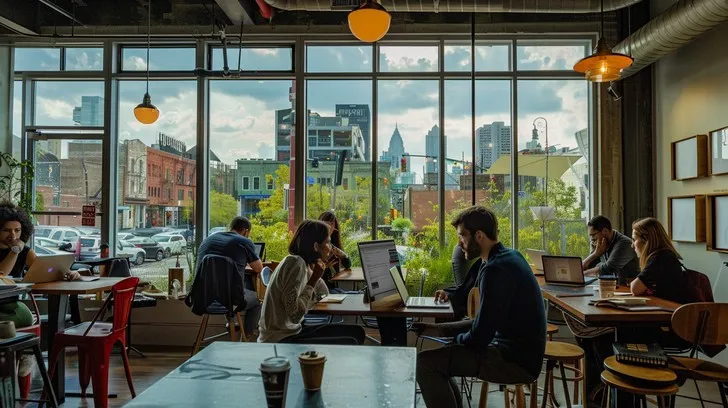
Your Brain on Beats and Espresso: The Unexpected Science Behind Café Breakthroughs

Photo by Photo by Ana Achim on Unsplash on Unsplash
The Moment You Stop Staring at a Blank Screen
It usually happens somewhere between the first sip and the second song. A freelance copywriter finally cracks the headline she's been wrestling with for three days. A product designer sketches out the feature his team has been stuck on for two sprints. An entrepreneur writes the pitch deck paragraph that's been missing for weeks. None of them planned for it. All of them were sitting in a café.
This isn't coincidence, and it isn't magic. It's biology — and the combination of caffeine, ambient sound, social energy, and live performance might be one of the most underrated creative tools in modern professional life.
What Caffeine Actually Does to a Thinking Brain
Most people treat coffee like a volume knob — something that turns up alertness and turns down fatigue. That's partially true, but the more interesting effect is what caffeine does to dopamine receptors. By blocking adenosine (the chemical that signals tiredness), caffeine doesn't just keep you awake. It primes your brain to receive reward signals more readily, which means ideas that feel satisfying — the ones that click — register with more intensity.
The catch is context. Caffeine amplifies whatever environment you're already in. Drink it alone in a quiet apartment, and you get sharper focus on whatever's directly in front of you — useful for execution, less useful for the kind of lateral thinking that produces original ideas. But drink it in a space with ambient stimulation — conversation, music, movement — and you get something different: a brain that's alert, reward-sensitive, and being gently pulled in multiple directions at once.
That last part matters more than most people realize.
The Sweet Spot Nobody Talks About
Researchers at the University of Illinois found that a moderate level of ambient noise — roughly 70 decibels, about the sound level of a busy café — enhances creative cognition compared to either silence or loud noise. The theory is that moderate distraction forces the brain to process information more abstractly, which is precisely the mental mode that produces novel connections.
Live music adds a layer that recorded playlists can't replicate. There's an unpredictability to a live performance — a chord choice you didn't expect, a tempo shift, a moment of silence before the next phrase — that keeps the auditory cortex lightly engaged without demanding full attention. Your conscious mind is focused on your work. Your subconscious is quietly free-associating to the music. The result, for a lot of people, is a kind of productive background hum that solo work environments simply don't produce.
"I've tried everything — noise apps, lo-fi playlists, white noise machines," says Marcus, a UX designer based in Chicago who spends two or three mornings a week working at a live café venue. "Nothing does what an actual room with actual people and actual music does. I don't know how to explain it except that my brain just... opens up."
Social Energy Without Social Obligation
There's another variable that rarely gets credited: the presence of other people who aren't demanding anything from you.
Open offices and team meetings carry cognitive load even when nothing is being asked of you directly. You're reading facial expressions, monitoring conversational dynamics, and staying alert for your name. Home offices carry a different kind of load — isolation, domestic distraction, and the absence of the subtle social pressure that keeps most people from fully disengaging.
A café occupies a third space that neither of those environments can replicate. You're surrounded by human activity — which satisfies a deep neurological need for social presence — but nobody needs anything from you. You're a participant in a shared environment without being a stakeholder in anyone else's agenda. Psychologists sometimes call this "co-working without co-working," and for a growing number of urban professionals, it's the only setting where they can sustain genuine creative focus for more than an hour.
Jenna, a novelist and marketing consultant in Austin, describes it this way: "At home I feel like I should be doing laundry. In a meeting I feel like I should be performing. At a café with live music, I feel like I'm allowed to just think. That's rarer than it sounds."
Why Live Performance Changes the Equation
Not every café creates this effect equally. The presence of live performance — even low-key acoustic sets, jazz trios, or singer-songwriters — introduces something that ambient music can't: human intention.
When a musician is performing in the same room, there's a shared energetic contract between performer and audience, even if most of the audience is looking at a laptop screen. That contract creates a kind of communal alertness. People sit up a little straighter. Conversations happen more naturally. The energy in the room has direction. And for creative professionals who feed off ambient human energy, that direction matters.
David, an entrepreneur in Nashville who's developed two of his company's core product concepts at a local live café, puts it plainly: "When someone's performing, the room has a pulse. And when the room has a pulse, I have one too. I've had more genuine breakthrough moments with a cup of coffee and a live set in the background than in any brainstorming session I've ever been paid to attend."
Timing It Right
If you want to use this deliberately — and more creatives are starting to — the timing of both the caffeine and the session matters. Neuroscientists generally recommend waiting 90 minutes to two hours after waking before having your first cup of coffee, allowing cortisol levels to drop naturally so the caffeine has maximum effect. Arriving at a café during an early live set — when the room is warming up but not yet at full volume — tends to hit that ambient noise sweet spot.
Bring the problem you're stuck on, not a to-do list. The café environment is better suited for generative thinking than task execution. Let the music do some of the work. Order something good. And resist the urge to put your headphones in.
The Office Never Had a Chance
Corporate environments were designed for coordination, not creation. Home setups were designed for comfort, not cognitive activation. Neither was built around the specific neurological conditions that make creative breakthroughs possible: moderate stimulation, social presence without social obligation, reward-primed attention, and the unpredictable energy of live human performance.
Cafés — especially ones that take both the coffee and the culture seriously — stumbled into that combination almost by accident. But the creatives who've figured it out aren't treating it like an accident anymore. They're treating it like a system. And for a lot of them, it's the most reliable one they've got.