How the Corner Table Became a Recording Studio: The Café Collaborations Nobody Planned
There's a particular kind of conversation that happens in live cafés that doesn't really happen anywhere else. It starts after a set, when the performer steps off the makeshift stage and grabs a drink. Someone at a nearby table leans over and says something genuine — not a pitch, not a networking opener, just a real reaction to what they heard. And sometimes, those thirty seconds of honest conversation turn into something neither person expected.
Across the country, live café venues are quietly functioning as one of the most effective incubators for musical collaboration that the industry has ever produced. Not because anyone designed them that way, but because the environment — relaxed, recurring, and built around shared experience — creates conditions that formal music industry structures almost never can.
The Accidental Meeting Place
The music industry has plenty of official channels for connecting artists. There are networking events, industry showcases, management introductions, and social media algorithms designed to surface potential collaborators. And yet, musicians and producers keep talking about the same kind of origin story for their most meaningful creative partnerships: they met somewhere low-stakes, probably over coffee, and the relationship built from there.
Live cafés fit that profile almost perfectly. They're places where musicians show up regularly — either to perform or simply because it's where their community gathers. There's no pressure to be "on," no pitch decks, no industry politics. Just people who love music, sharing a physical space over and over again until familiarity turns into friendship and friendship turns into something creative.
"I've booked probably four hundred shows over the last six years," says Jamie Okafor, who manages programming at a live café in Nashville. "I've lost count of how many times I've watched two artists who met here end up on a record together. It happens constantly. And it almost always starts the same way — they're both regulars, they start talking, and then one of them shows up at the other one's show. The rest writes itself."
Why Regulars Are the Secret Ingredient
The word that comes up again and again in these conversations is regulars. Not the occasional drop-in crowd, but the people who show up week after week — the ones who know the staff by name, who have a usual order, who arrive early enough to snag the same table.
Regularity matters because creative trust takes time. You can't rush it, and you can't manufacture it in a single networking event. But when two musicians spend months occupying the same room, watching each other perform, overhearing each other's conversations about influences and frustrations and ambitions, something organic develops.
For Brooklyn-based folk duo Clearwater & Glass, that's exactly how it started. Mara Ellison and Devon Park had both been performing solo at the same café in Greenpoint for almost a year before they actually sat down and talked.
"We'd wave at each other, do that performer nod thing," Mara says with a laugh. "But we'd never really talked. Then one night there was a snowstorm and like six people showed up to the show. We both played short sets and then just sat there for two hours because neither of us wanted to go out in the weather. That was it. That was the conversation that started everything."
Their debut EP, recorded the following spring, came directly out of that snowstorm conversation. They've since toured regionally together and are working on a full-length album.
The Informal Audition Nobody Knows They're Giving
There's another dynamic at play in live café settings that you don't get from a demo submission or an industry showcase: the chance to watch someone work in real conditions, over a long period of time.
When you see a musician perform in a café setting — stripped down, no production budget, just them and their instrument and a room full of people having conversations — you learn things about them that a polished studio recording will never tell you. You see how they handle a distracted audience. You see whether they're genuinely connected to the material or just technically proficient. You see their personality between songs, which tells you more about what it would be like to work with them than almost anything else.
Producer and multi-instrumentalist Cal Reyes, who's based in Portland, says this kind of extended observation has shaped most of his collaborative decisions.
"I've passed on working with people who had incredible demos because I watched them perform live and something felt off — not musically, just in terms of how they carried themselves, how they treated the audience," he says. "And I've reached out to artists I'd never heard of before just because I saw them play at a café and something clicked. The live café setting is basically a long audition that nobody knows is happening."
When the Coffee Shop Becomes the Creative Space
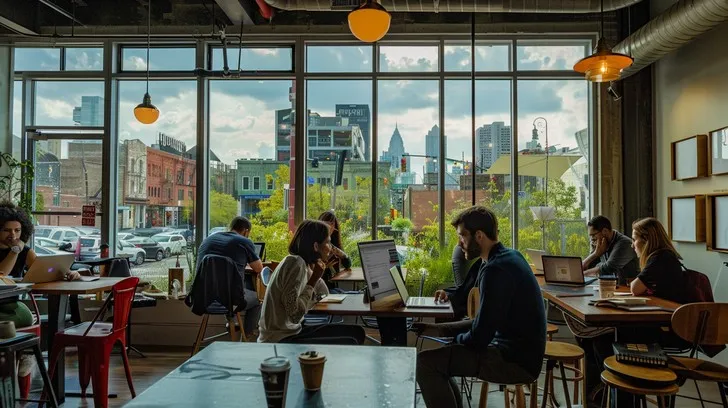
For some collaborators, the café doesn't just facilitate the introduction — it stays central to the creative process itself. Working from a café table, surrounded by ambient sound and the low hum of community, suits certain creative temperaments in ways that a studio or rehearsal space doesn't.
There's actually research supporting the idea that moderate ambient noise — the kind you'd find in a busy but not overwhelming café — can enhance certain types of creative thinking. The slight distraction keeps the analytical brain busy enough to let more associative, creative thinking flow more freely. Whether or not artists know the science behind it, a lot of them describe the feeling intuitively.
"Some of our best song ideas came from sitting in the back corner with laptops, just writing while everything was happening around us," says Devon Park of Clearwater & Glass. "There's something about not being in a vacuum that keeps the writing honest. You're writing for a room because you're already in one."
What Café Owners Are Starting to Understand
Some venue owners are beginning to recognize the collaborative ecosystem their spaces are nurturing — and finding gentle ways to support it without over-engineering something that works precisely because it's informal.
This might look like maintaining a community board where local musicians can post about projects they're looking to develop. Or hosting occasional low-key "open lab" nights where artists can play unfinished material to a small, trusted audience. Or simply making sure the schedule includes enough recurring performers that a community of regulars actually has the chance to form.
"The worst thing you can do is try to turn it into a program," Jamie Okafor says. "The moment it becomes a structured thing, it loses the thing that made it work. You're just creating the conditions and getting out of the way."
The Longer Arc
What's notable about the collaborations that emerge from live café culture is how durable they tend to be. These aren't transactional partnerships built on mutual career benefit — they're friendships first, creative relationships second. And that order of operations matters enormously when creative disagreements arise, when schedules get hard, when the work gets frustrating.
In an industry that can feel increasingly mediated by algorithms, streaming metrics, and platform strategy, there's something quietly radical about a musical partnership that started because two people kept showing up to the same room and eventually had something real to say to each other.
The corner table, it turns out, has always been one of the best places to begin.