No Office, No Living Room, No Problem: The Live Café as America's Missing Middle Ground
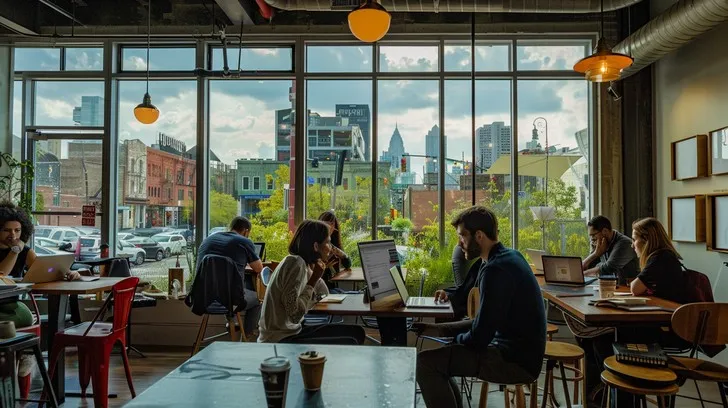
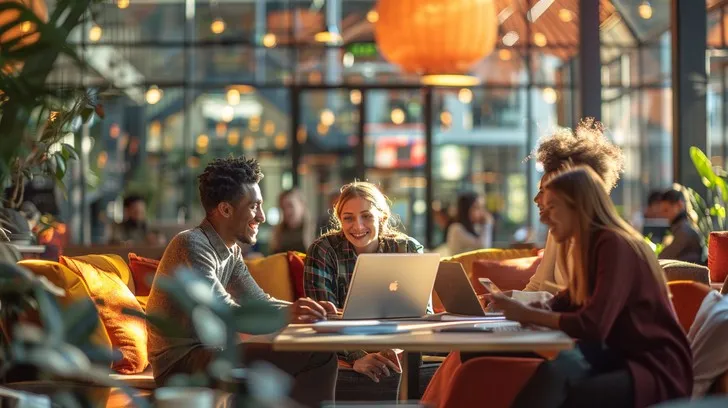
Photo: urban professionals community gathering coffee shop social space, via images.stockcake.com
Something quietly broke in American social life over the last several years, and a surprising number of people are finding the fix in the same place: a café with a stage and good coffee. As traditional community anchors lose their grip, live café venues are stepping into a role that nobody officially assigned them — and pulling it off.
The concept of the "third place" — a term coined by sociologist Ray Oldenburg in the late 1980s to describe spaces that are neither home nor work but essential to civic health — has been circulating in urban planning and sociology circles for decades. Libraries, barbershops, diners, community centers: these were the connective tissue of American neighborhoods. But a combination of economic pressure, pandemic disruption, and shifting social habits has left that tissue frayed. And the places stepping into the gap aren't the ones most planners would have predicted.
The Data Behind the Disconnection
The numbers on American social isolation have been grim for a while, but the post-pandemic period accelerated trends that were already underway. A 2023 report from the U.S. Surgeon General formally identified loneliness as a public health crisis, noting that roughly half of American adults reported measurable levels of social isolation. Among urban professionals — a demographic with high mobility, demanding schedules, and often limited geographic roots — those numbers skew even higher.
At the same time, the spaces that traditionally served as antidotes to isolation have been shrinking. Public library hours have been cut in cities across the country. Religious attendance has declined steadily for two decades. The pandemic-era shift to remote work eliminated the office as a social environment for millions of people — and for many, it never fully came back. Even bars and restaurants, long reliable gathering spots, have seen shifts in how people use them: more delivery, less lingering.
What's emerged in the gap is a demand for spaces that offer something specific: ambient community. Not forced interaction, not programmed socializing, but the low-pressure presence of other people doing their own thing in a shared space — ideally with something worth showing up for.
Why the Stage Changes Everything
A coffee shop alone can approximate some of that. People work, read, and decompress in cafés every day. But there's something that shifts when you add live performance to the equation.
Music, even background music performed live, changes the social dynamics of a room in measurable ways. It gives strangers a shared reference point — something to react to, comment on, or simply experience together without needing a formal introduction. It creates what researchers sometimes call "social facilitation": the presence of others engaged in a common experience lowers the psychological friction of interaction.
In practical terms, this means people at a live café venue are more likely to make eye contact, start conversations, and stay longer than they would in a standard café or a traditional concert setting. The combination is doing something that neither element does as well alone.
"I've watched people who come in alone leave with plans to come back with someone," says a regular at a live café venue in Chicago's Logan Square neighborhood. "It's not like a networking event where you feel like you have to be 'on.' It's just easier to talk to people here. The music gives you something to talk about."
The Urban Professional Equation
For the urban professional demographic specifically, live café venues are filling a surprisingly complex set of needs that used to be distributed across multiple institutions.
The office provided structure, ambient social contact, and a sense of professional identity. Home provided comfort and recovery. Third places — the neighborhood bar, the gym, the community organization — provided everything in between. Remote and hybrid work collapsed those categories in ways that many people are still sorting out.
A live café venue, at its best, can serve as a surprisingly effective substitute for several of those functions at once. It offers the low-stakes social presence of an office without the professional hierarchy. It provides the comfort and informality of a neighborhood spot without the pressure of a bar environment. And the live programming gives it something most of those other spaces never had: a reason to look up from your laptop.
For people who work from home and live alone — a demographic that's grown significantly in major U.S. cities — the ritual of going to a place like this a few times a week can be genuinely stabilizing. Not in a clinical sense, but in the everyday sense of having somewhere to be that isn't your apartment.
Creative Collision and Civic Life
Beyond individual wellbeing, live café venues are also becoming incubators for the kind of spontaneous creative and civic activity that used to happen in other community spaces.
In cities where affordable rehearsal space is scarce and co-working has gotten expensive, the live café has become a spot where musicians, writers, designers, and other creative workers cross paths in ways that generate real collaboration. It's not a co-working space — nobody's paying for a desk — but the density of creatively-minded people in an environment that values artistic expression produces similar results.
There's also a civic dimension that's easy to overlook. Community meetings, local political organizing, small-scale fundraisers, open mics that double as platforms for spoken word and social commentary — these things happen at live café venues because the space is designed for gathering and for voice. In neighborhoods where other civic infrastructure has eroded, that matters.
The Limits of the Model
It would be naive to suggest that a café with a stage can replace public libraries, community centers, or robust civic infrastructure. It can't, and the people who run these venues would be the first to say so. Live café venues are businesses, with rent and payroll and the constant pressure to fill seats. They can't operate on the logic of a public institution.
But they don't have to be public institutions to do public good. The best ones have found a model where the commercial and the communal reinforce each other — where a full house for a Thursday night set also happens to be a neighborhood gathering, where the regulars who keep the café financially viable are also the community that gives it meaning.
The Simplest Infrastructure
There's something almost poignant about the fact that the spaces filling America's third-place gap are built around two of the most ancient human rituals: sharing food and drink, and making music together. The specifics are modern — the espresso machine, the PA system, the Instagram story about tonight's set — but the underlying need is as old as any community has ever been.
Urban professionals, creatives, remote workers, and neighborhood regulars are finding their way to live café venues not because they've read the sociology literature on social infrastructure, but because something in these spaces feels like what was missing. That instinct is worth paying attention to.
The third place isn't gone. It just moved somewhere with better coffee.