Serendipity Over Spreadsheets: How the Live Café Is Quietly Replacing the Networking Event
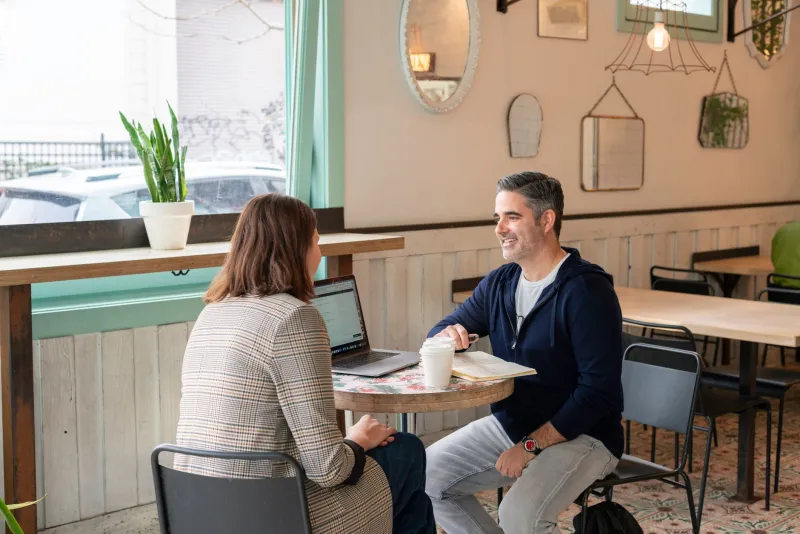
There's a moment that Marcus Webb, a freelance UX designer based in Chicago, describes with almost suspicious precision. He was on his third cup of coffee, half-listening to a jazz trio work through a slow Thursday night set, when the woman at the next table leaned over and asked if he knew the song. He didn't. She did. Twenty minutes later, they were talking about a product launch she was struggling to visualize. Six weeks after that, he was her lead designer.
"No LinkedIn message would have gotten me that gig," Marcus says. "I'd sent a hundred of those. What worked was a conversation that started because we both liked the same song."
This is the latte effect in action — and it's reshaping how remote workers and entrepreneurs think about professional connection.
The Problem With Formal Networking
The traditional networking event has a trust problem. Walk into any Chamber of Commerce mixer or industry happy hour and you'll find a room full of people performing confidence while quietly calculating ROI on every handshake. Everyone knows why everyone else is there. The transactional nature of it is baked into the room itself — the nametags, the sponsor banners, the 90-second pitch ritual.
Psychologists who study social bonding have a term for this dynamic: instrumental interaction. It's connection with an explicit goal attached, and research consistently shows it produces weaker, shorter-lived relationships than connection that forms organically around shared experience. When both parties know they're networking, the authenticity ceiling drops fast.
Live café spaces flip this entirely. Nobody walks into a venue like Live Café 385 to network. They come for the coffee. They stay for the music. And somewhere in between, real conversations happen.
Why Live Music Is the Secret Ingredient
It sounds counterintuitive at first. Wouldn't a live performance make it harder to have a conversation? In practice, the opposite tends to be true — at least in the low-key, ambient-volume sets that define the best café stages.
Live music creates what social scientists call a shared focal point: a common experience that gives strangers an immediate, low-stakes reason to interact. Commenting on a song, a musician's technique, or even just the vibe of a particular set is a social permission slip. It removes the cold-open problem that kills most networking attempts before they start.
There's also something about the emotional register of live music that loosens professional armor. A well-chosen acoustic set can shift the mood of a room in ways that a Spotify playlist simply cannot — partly because it's happening in real time, and partly because the performer is a human being you can watch, react to, and talk about. That shared humanity bleeds into the conversations happening around the room.
Jordan Ames, who runs a small marketing consultancy out of Austin, puts it bluntly: "I've been to $500 industry conferences that produced zero useful contacts. But I've had three client relationships start at coffee spots with live music. There's something about that environment that makes people real."
The Affordable Alternative to Co-Working
There's also a practical economics story here. Dedicated co-working spaces have exploded in major US cities over the past decade, but the costs have followed. A hot-desk membership in Manhattan or San Francisco can run $300 to $600 a month — a meaningful expense for solopreneurs and early-stage freelancers watching every dollar.
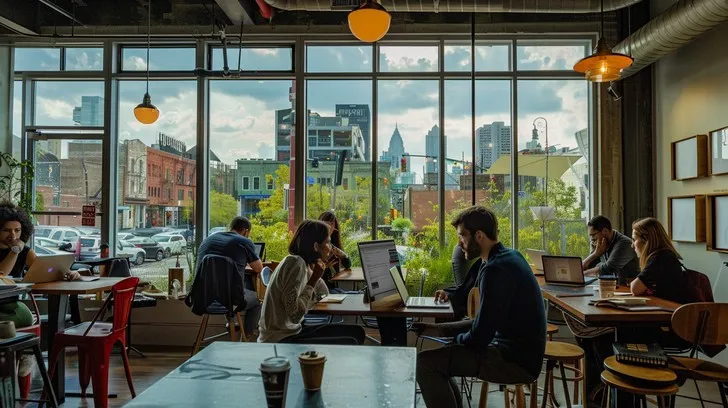
A live café offers a compelling alternative. The price of a good latte and maybe a pastry buys you hours of ambient workspace, reliable WiFi, and — critically — a social environment that a co-working cubicle can't replicate. You're not isolated in a pod. You're part of a room that has energy, rhythm, and the occasional conversation that changes the direction of your week.
This is particularly true for remote workers who've discovered that the home office, for all its convenience, tends to flatten the serendipitous collisions that used to happen in open-plan offices. The hallway conversation. The accidental lunch with someone from a different department. The random introduction at the coffee machine. Live cafés are quietly filling that gap.
"I work from home four days a week," says Priya Nair, a product manager in Denver who's become a regular at her neighborhood's live music café. "The fifth day I'm here. And honestly, more interesting professional things have happened on that fifth day than in all the Zoom calls combined."
The Psychology of Productive Serendipity
Researchers at MIT's Human Dynamics Lab have spent years studying what makes workplace relationships productive, and one of their consistent findings is that proximity and shared rhythm drive connection more than intentional networking. People who share physical space and move through similar daily patterns build trust faster and collaborate more naturally.
The live café models this beautifully. Regulars develop a kind of ambient familiarity — you recognize faces, you share the experience of a particularly good set, you develop a shorthand that doesn't require a formal introduction. By the time a real conversation happens, the groundwork is already laid.
This is what makes the live café fundamentally different from a co-working space, even a social one. A co-working space is organized around work. A live café is organized around experience — and work, for many of its regulars, just happens to follow.
What This Means for the Future of Professional Community
The shift is still early, but the signals are consistent. Across US cities, the venues that combine quality coffee with genuine live programming are attracting a demographic that traditional networking spaces haven't cracked: the independent professional who's allergic to forced interaction but genuinely hungry for community.
These aren't people who want to be sold to. They want to be in a room where interesting things are happening, where the coffee is good, and where a real conversation might break out over a shared appreciation for a well-executed guitar solo. That's not a niche preference — it's increasingly the dominant mode of how urban professionals want to spend their time.
For venues like Live Café 385, the opportunity is clear: the stage and the espresso machine aren't just amenities. They're infrastructure for a kind of human connection that the formal professional world has been failing to provide for years.
Marcus Webb, the Chicago designer, has a simple way of putting it: "The best business relationships I have started because we were both somewhere worth being. That's it. You just have to be somewhere worth being."
Pull up a stool. The set starts at eight.